


The Most Commonly Asked Questions About Online Marketing (And Their Answers) 2026

Updated: 2 days ago
Online marketing is a constantly evolving field, and with so many strategies, tools, and techniques available, it’s no surprise that marketers and business owners have a lot of questions.
Understanding the fundamentals is key to success, whether you're just starting out or looking to refine your digital marketing strategy.
In this article, we’ll cover some of the most commonly asked questions about online marketing, providing clear answers and actionable insights.
1. What is online marketing, and why is it important?

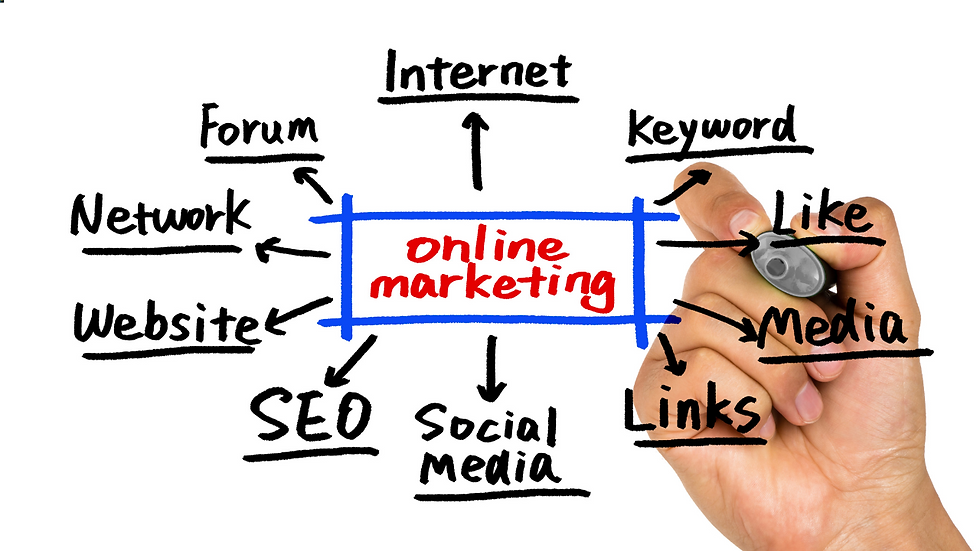
Online marketing, also known as digital marketing, refers to the promotion of products or services using the internet and digital channels. It includes strategies like search engine optimization (SEO), social media marketing, email marketing, content marketing, and paid advertising.
Online marketing is crucial because it allows businesses to reach a global audience, target specific demographics, and track real-time performance.
2. What are the best digital marketing strategies for beginners?

There are many different effective strategies to drive traffic to your website, business, or product offering.
Here are those which I have found to be the most effective at bringing in warm leads that can easily be converted to paying customers:
SEO (Search Engine Optimization): Optimize your website to rank higher on search engines. SEO takes time and effort to perfect, but it is easily the best free way to drive traffic to your website.
Content Marketing: Create valuable content that educates and engages your audience. This content can come in the form of digital tools, informative blog posts, engaging videos, and much more.
Social Media Marketing: Build a presence on platforms like Facebook, Instagram, LinkedIn, or Twitter. Social media marketing is a highly effective method because developing a large following gives you social proof, which makes potential customers feel more at ease when buying from or working with your brand.
Email Marketing: Use email campaigns to nurture leads and retain customers. The rule of 7's states that the average customer has seen a product 7 times before making the decision to buy it. Email marketing allows you to establish sustained correspondence with prospective customers, which will enable you to build rapport and potentially increase sales on the back end of your campaigns.
Pay-Per-Click (PPC) Advertising: Pay-Per-Click is the practice of running targeted ads on Google, Facebook, or other platforms. You choose niche related keywords or develop a target audience and then run ads to that audience paying only when people click on your ad to view your offer. This is the fastest method to get traffic to your offer, and also tends to be the most scalable as the only restraints are the audience of your niche and your marketing budget.
3. How long does it take to see results from online marketing?
Different strategies require different timeframes to experience success:
SEO: 3 to 6 months for noticeable ranking improvements.
Getting the ball rolling with SEO takes lots of time and effort because you have to build up a catalog of work for search engines to rank and drive traffic to. It is highly effective, however, because once your site ranks, it receives free traffic in perpetuity. You can continue to get customers for years to come with minimal effort or investment on the back end.
Content Marketing: 3 to 6 months to build authority and organic traffic.
Much like SEO, content marketing requires a high degree of upfront effort in the form of time and/or money to create an offer or resource that is appealing to customers. However, once your value creation device is completed, you can continue to use it to drive traffic far into the future with minimal continued effort or financial investment.
Social Media Marketing: Can take weeks to months to grow an engaged audience.
Social Media Marketing is the best strategy when it comes to demonstrating authority to prospective customers. Growing and maintaining a following proves to those experiencing your web presence for the first time that you are a trustworthy entity, which in turn increases confidence in any products that you may market to them.
PPC Advertising: Immediate results, but requires ongoing optimization.
PPC Advertising offers the fastest results of any major online marketing strategy. Simply build a landing page, find keywords related to your product, set up tracking, and start advertising your product.
While it is the fastest way to get traffic flowing, it does require constant optimization to ensure that you are making the most of your money.
4. How can I improve my website’s SEO?

Ranking through SEO is perhaps the single best way to send traffic to your website. To get your site ranking in Google, Bing, and other platforms, there are a few steps that you have to follow:
Conduct keyword research to target relevant search terms.
Optimize title tags, meta descriptions, and headers.
Improve site speed and mobile-friendliness.
Create high-quality, valuable content.
Build backlinks from reputable websites.
Optimizing your website for SEO takes time, effort, and commitment, but it is well worth it in the long run as it can secure you free high-converting traffic long into the future.
For a full overview of how to use SEO to rank your website and drive free traffic to your offers you can read this article or check out our review of the top 2 website builders here
5. What social media platform should I focus on for my business?

With over 5.1 billion active users worldwide (64% of the total population), social media is the most prominent medium in the world when it comes to advertising your business. Choosing the right platform is key as each application has a different customer base with different wants and needs that must be met.
The best platform depends on your business type and audience:
Facebook: Best for broad audiences and advertising.
Instagram: Ideal for visual brands, influencers, and eCommerce.
LinkedIn: Great for B2B marketing and networking.
Twitter: Good for news, trends, and customer engagement.
TikTok: Effective for short-form video content and younger demographics.
*It is easy to overextend yourself by trying to learn/utilize multiple social platforms at the same time. For best results, pick one and stick with it until you master it before moving on to the next.
6. How do I grow my social media following?

While growing a strong social media is not necessary for all businesses, it can help to increase the apparent authority of your website and drive more traffic to your offers.
Growing a social media following takes time and consistency. For best results, follow these steps:
Post high-quality, engaging content regularly.
Interact with followers through comments and messages.
Use hashtags strategically.
Collaborate with influencers or brands in your niche.
Run social media ads to expand your reach.
7. What is email marketing, and how can I use it effectively?

Email marketing involves sending emails to a list of subscribers to nurture relationships and drive sales. Multiple studies suggest that the average customer has to see a product 7 or more times before making the decision to buy it. Email marketing allows you to remarket customers, keeping your business at the forefront of your customers' minds and, hopefully, wallets.
To make it effective:
Personalize emails based on subscriber preferences.
Use compelling subject lines to boost open rates.
Provide valuable content instead of just promotions.
Segment your email list for targeted messaging.
Automate campaigns for efficiency.
Check our our review of the top 2 email marketing funnel builders here
8. What is the difference between organic and paid traffic?

Both organic and paid traffic can be highly beneficial to your company's website converting into leads and eventually sales.
Organic Traffic: Visitors who find your website through unpaid methods, like search engines or social media. Organic traffic is typically a slow-burn method requiring you to gain authority in your niche to succeed. Still, it is highly sustainable and tends to have higher conversion rates once that authority is achieved.
Paid Traffic: Visitors acquired through advertising, such as Google Ads, Facebook Ads, or sponsored content. You can start driving paid traffic to your website in a matter of minutes making it much more rapid and time effective than organic traffic. However, it does still take time and financial expenditure to optimize campaigns.
Both have their advantages; organic traffic is cost-effective long-term, while paid traffic delivers quicker results.
9. How do I create high-converting landing pages?

Have you ever heard the phrase, "You never get a second chance to make a great first impression"? Your business' landing page is the most critical aspect of your website because it is the first impression prospective customers will get of your brand.
A good or bad landing page can make or break your online business.
Well-optimized landing pages can significantly boost conversions. Key elements include:
A compelling headline that grabs attention.
Clear and concise copy that communicates value.
High-quality visuals that support your message.
A strong call-to-action (CTA) that encourages visitors to take the next step.
Minimal distractions (remove unnecessary links or clutter).
Both Ubersuggest and Getresponse are great landing page builders. Check out which one will work best for you here
10. How can I measure the success of my online marketing campaigns?

Quality analytical tools are imperative to your online business because they allow you to determine what is working and what isn't. This is imperative in a world where making a few small alterations can save you countless dollars and hours of time.
Use these analytics tools to track performance:
Google Analytics: Monitors website traffic and user behavior.
Facebook Insights: Tracks engagement and ad performance on Facebook.
Email Marketing Analytics: Measures open rates, click-through rates, and conversions.
SEO Tools (Ahrefs, SEMrush, Moz): Analyze search rankings and keyword performance.
11. What are common mistakes to avoid in online marketing?

In the world of online marketing a few small mistakes can mean the difference between a successful venture, and heartbreaking failure.
Here is a short list of some of the most common mistakes I often see in the world of online marketing.
Ignoring SEO best practices.
Posting inconsistent or low-quality content.
Neglecting email list segmentation.
Not setting clear goals or tracking results.
Overspending on ads without optimizing campaigns.
12. How do I generate more leads online?

No matter how great your product, you will never make a sale if you can't generate leads. This can be done by offering free products (Lead Magnets) such as ebooks, free trials, and information, running ads, and much more.
Always remember, the best way to turn these leads into paying customers isn't through selling, but rather by providing value, and proving yourself as an authority in the subject matter.
To attract more leads, try:
Offering valuable lead magnets (eBooks, checklists, free trials).
Optimizing website forms for easy conversions.
Running targeted ads on Google and social media.
Hosting webinars or live Q&A sessions.
Leveraging influencer marketing and collaborations.
One of the top ways to bring in free leads is through building a website with a well constructed blog.
13. Should I invest in paid ads, and which platform is best?

While free traffic gained from SEO and Social media is great for any business, paid ads are a much faster and sometimes more profitable method to get high-quality converting traffic to your website.
Paid ads can deliver fast results if used correctly. Choose a platform based on your audience:
Google Ads: Best for search intent-driven leads.
Facebook & Instagram Ads: Great for brand awareness and engagement.
LinkedIn Ads: Effective for B2B marketing.
YouTube Ads: Useful for video-based promotions.
14. How do I keep up with online marketing trends?

As with every aspect of business, staying up to date with marketing trends requires constant research, creativity, and above all else, self-education. You can learn invaluable information from a variety of online resources like blogs, webinars, and peer to peer relationships fostered during your time within the industry.
Do your research, use common sense, and you will undoubtably succeed given time and patience.
Stay updated by:
Following industry blogs (Moz, HubSpot, Neil Patel, etc.).
Attending webinars and conferences.
Testing new strategies and learning from analytics.
Final Thoughts
Online marketing is a powerful way to grow your business, but it requires continuous learning and adaptation. By understanding the fundamentals, avoiding common mistakes, and leveraging the right strategies, you can build a strong digital presence and achieve long-term success.
Got more questions?
Drop them in the comments, and I’ll be happy to answer!


Comments